
8D
Awareness Training
Build practical 8D problem-solving skills to identify root causes, implement effective corrective actions, prevent recurrence, and strengthen structured team-based problem solving.
Understand 8D | Solve problems systematically | Prevent recurrence
What is 8D
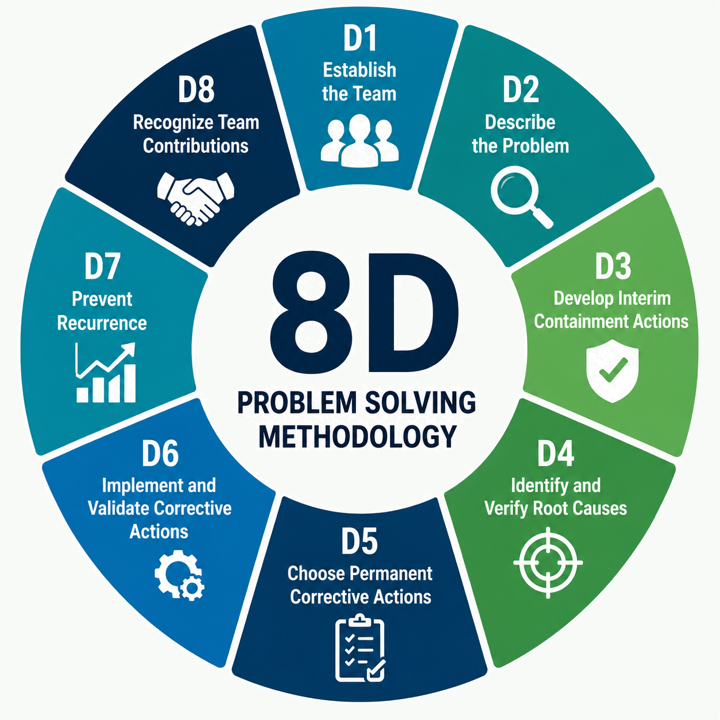
8D (Eight Disciplines) Problem Solving is a structured, team-based approach for identifying, containing, and permanently resolving recurring or significant problems. It guides teams through a systematic process from problem identification and immediate containment to root cause analysis, corrective action, prevention of recurrence, and recognition of the team.
8D is widely used in manufacturing, automotive, engineering, quality management, and supply chain environments to address customer complaints, product defects, process failures, and other quality problems. The 8D methodology helps organizations move beyond treating symptoms and focus on identifying and eliminating the underlying causes of problems.
Why 8D?
Effective problem solving requires more than correcting an immediate defect. 8D problem solving provides a disciplined framework that helps organizations understand why a problem occurred, take appropriate corrective action, and prevent it from happening again.
An 8D approach can help organizations:
- Establish a structured and systematic problem-solving process
- Contain problems quickly and minimize their impact
- Identify and verify root causes rather than addressing symptoms
- Develop and implement effective corrective actions
- Prevent the recurrence of similar problems
- Encourage cross-functional teamwork and collaboration
- Improve the effectiveness of quality and corrective action processes
- Strengthen customer complaint and supplier problem-solving practices
- Develop a culture of continuous improvement and preventive thinking
8D – Training Topics
The 8D Awareness Training introduces participants to the principles, structure, and practical application of the 8D problem-solving methodology. Key topics include:
- Introduction to 8D Problem Solving
- When and why to use the 8D methodology
- Understanding the D1–D8 disciplines
D1 — Establish the Team
Form a cross-functional team with the knowledge, skills, and authority required to investigate and resolve the problem. The team should include people who understand the affected process, product, quality requirements, and relevant technical aspects.
Objective: Bring together the right expertise to effectively solve the problem.
D2 — Describe the Problem
Clearly define the problem using facts and data rather than assumptions. The problem statement should explain what happened, where it occurred, when it occurred, how frequently it occurs, and its extent or impact.
Objective: Develop a clear, measurable understanding of the problem.
D3 — Implement Interim Containment Actions
Take immediate action to contain the problem and protect the customer or subsequent processes while the permanent root cause is being investigated. Examples may include inspection, segregation, rework, temporary process controls, or controlled release.
Objective: Minimize the impact of the problem until a permanent solution is implemented.
D4 — Identify and Verify the Root Cause
Investigate the problem systematically to identify its root cause and the reason the problem was not detected or prevented. Appropriate problem-solving tools may include the 5 Whys, fishbone analysis, Pareto analysis, process analysis, and data-based investigation.
The suspected causes should be verified with objective evidence rather than accepted based on assumptions.
Objective: Determine the actual cause of the problem and verify it with evidence.
D5 — Choose and Verify Permanent Corrective Actions
Develop potential corrective actions that eliminate the verified root cause. The selected actions should be evaluated and verified to ensure they can effectively resolve the problem without creating unintended consequences.
Objective: Select a permanent corrective action that addresses the verified root cause.
D6 — Implement and Validate Permanent Corrective Actions
Implement the selected corrective actions and monitor their results. Objective evidence should demonstrate that the actions have effectively eliminated the problem and its root cause.
Interim containment measures can then be removed or revised when appropriate.
Objective: Confirm that the permanent corrective actions work effectively in the actual process.
D7 — Prevent Recurrence
Make the necessary systemic changes to prevent the same or similar problem from occurring again. This may involve updating procedures, work instructions, control plans, risk assessments, training, process controls, inspection methods, or other relevant management systems.
Objective: Prevent recurrence by addressing weaknesses in the wider system or process.
D8 — Recognize the Team
Formally recognize the contributions of the team and individuals involved in resolving the problem. Sharing lessons learned can also help the organization apply the knowledge gained to similar processes or future problems.
Objective: Recognize the team’s contribution, capture learning, and reinforce a culture of collaborative problem solving.
Why choose NIBUNAR?
NIBUNAR’s 8D Awareness Training focuses on making problem solving practical, understandable, and applicable to real workplace situations. Rather than treating 8D as simply a documentation exercise, the training helps participants understand how structured problem solving can be applied to actual quality and process-related challenges.
Participants benefit from:
- Practical, application-oriented learning rather than theory alone
- Clear understanding of each discipline in the 8D process
- Real-world examples and industry-relevant problem scenarios
- Interactive discussions and practical exercises
- Focus on root cause analysis, corrective action, and prevention
- Guidance on applying 8D principles within existing quality processes
- Training that can be adapted to the organization’s industry, processes, and learning requirements
The objective is to help participants confidently understand and contribute to structured 8D problem-solving activities within their organizations.
Frequently Asked Questions
What is 8D
8D (Eight Disciplines) is a structured problem-solving methodology used to identify root causes, implement corrective actions, and prevent recurring issues.
What is the duration of 8D training?
1 Day (Approximately 8 Hours)
Training can be delivered:
- Classroom
- Live Online
- On-site Corporate Training
Is this training suitable for beginners?
Yes. This awareness training is designed for beginners as well as professionals who want to understand the fundamentals of the 8D methodology
Is prior knowledge required?
No prior knowledge is required.
Will practical examples be included?
Yes. Participants will learn through real-world examples, discussions, and case studies.
Is a certificate provided?
Yes. All eligible participants will receive a Certificate of Participation.
Connect with NIBUNAR
Looking to build awareness of 8D problem solving approach for your organization?
Connect with NIBUNAR to discuss your 8D Awareness Training requirements, participant profile, preferred training format, and organizational objectives.
Whether you are introducing 8D for the first time or strengthening a the problem solving approaches, NIBUNAR can help you develop a practical learning program suited to your organization.
Talk to NIBUNAR for 8D awareness training
1234+91 75 98765 741
1234reachus@nibunar.com
Connect with NIBUNAR
for 8D awareness training