
IATF 16949
Internal Auditor Training
Build practical IATF 16949 internal auditing skills to plan, conduct and report effective audits, identify nonconformities, assess process risks, and support continual improvement in automotive quality management systems.
Understand IATF 16949 | Audit processes effectively | Drive continual improvement
What is IATF 16949?
IATF 16949 is an internationally recognized Quality Management System (QMS) standard developed specifically for the automotive industry. It is based on ISO 9001 and incorporates automotive-specific requirements aimed at improving product quality, process performance, defect prevention and customer satisfaction throughout the automotive supply chain.
IATF 16949 emphasizes a process-based approach, risk-based thinking, customer-specific requirements, defect prevention, continual improvement and effective control of manufacturing and support processes.
IATF 16949 Internal Auditor Training helps participants understand the standard’s requirements and develop the competence required to plan, conduct, document and report effective internal audits of an automotive quality management system.
Why IATF 16949?
The automotive industry demands consistent quality, reliable processes and effective control of risks across the entire supply chain. IATF 16949 provides a structured framework for organizations to establish and continually improve their automotive quality management systems.
Implementing and maintaining IATF 16949 can help organizations:
- Improve product and process quality.
- Strengthen process control and performance.
- Focus on defect prevention rather than detection alone.
- Identify and manage quality-related risks.
- Improve customer satisfaction and confidence.
- Address applicable customer-specific requirements.
- Strengthen supplier and supply chain performance.
- Establish a culture of continual improvement.
- Support compliance with automotive industry requirements.
Effective internal auditing is essential to verify whether the IATF 16949 QMS is effectively implemented, maintained and capable of achieving intended results.
Principles of IATF 16949
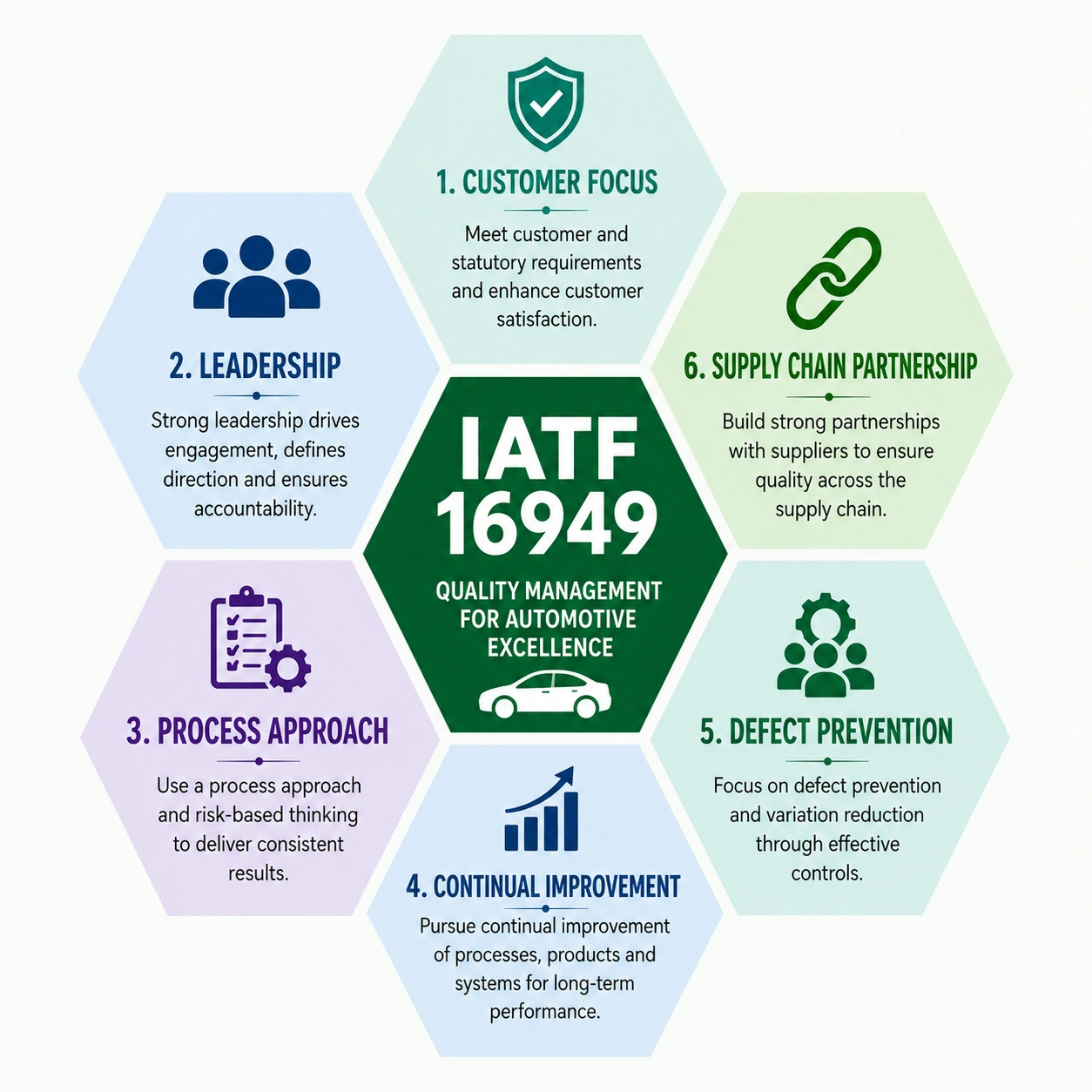
IATF 16949 incorporates the quality management principles of ISO 9001 while adding requirements specific to the automotive industry. Key principles relevant to effective internal auditing include:
1. Customer Focus
Organizations need to understand and consistently meet customer requirements, including applicable customer-specific requirements (CSRs), statutory and regulatory requirements.
2. Leadership
Leadership establishes direction, accountability and commitment to the quality management system. Effective leadership helps create a culture focused on quality, customer satisfaction and continual improvement.
3. Process Approach
IATF 16949 promotes managing activities as interconnected processes. Internal auditors evaluate how processes are planned, implemented, monitored and improved rather than looking only at individual documents or departments.
4. Risk-Based Thinking
Organizations are expected to identify and address risks that could affect product and process performance. Auditors therefore need to evaluate how risks are identified, controlled and monitored.
5. Defect Prevention
A major focus of IATF 16949 is preventing defects rather than relying solely on inspection and detection. Effective controls, error-proofing and process monitoring contribute to this objective.
6. Continual Improvement
Organizations should continually improve the suitability, adequacy and effectiveness of their QMS, processes and products using performance data, audit results, corrective actions and other improvement opportunities.
7. Evidence-Based Decision Making
Decisions should be supported by relevant data and objective evidence. Internal auditors use objective evidence to determine conformity and identify opportunities for improvement.
8. Supply Chain Management
Automotive quality depends on effective control and development of the supply chain. IATF 16949 places significant emphasis on supplier performance, monitoring, development and quality assurance.
IATF 16949 Internal Auditor – Training Topics
The training is designed to develop the practical competence required to conduct effective IATF 16949 internal audits.
Understanding IATF 16949
- Overview and purpose of IATF 16949
- Relationship between IATF 16949 and ISO 9001
- Structure and key requirements of IATF 16949
- Automotive industry-specific requirements
- Customer-specific requirements
- Risk-based thinking and process approach
Internal Audit Fundamentals
- Purpose and objectives of internal auditing
- Types of QMS audits
- Audit principles and auditor responsibilities
- Auditor competence and impartiality
- Audit programme and audit planning
- Defining audit scope and criteria
Planning an IATF 16949 Internal Audit
- Understanding the organization’s processes
- Developing an audit plan
- Preparing audit checklists
- Identifying process risks and critical areas
- Reviewing previous audit findings and corrective actions
- Determining appropriate audit trails
Conducting the Audit
- Opening meeting
- Process-based auditing
- Interviewing and effective questioning
- Gathering objective evidence
- Sampling techniques
- Following audit trails
- Evaluating process effectiveness
- Identifying conformity and nonconformity
Nonconformity and Audit Findings
- Identifying and documenting nonconformities
- Linking findings to applicable requirements
- Writing clear and objective audit findings
- Understanding correction and corrective action
- Evaluating root cause and corrective action
- Follow-up and verification of effectiveness
Audit Reporting and Follow-Up
- Preparing audit reports
- Communicating audit results
- Closing meetings
- Monitoring corrective actions
- Verification of corrective action effectiveness
- Continual improvement based on audit results
Practical Application
- Automotive-related audit case studies
- Practical audit exercises
- Scenario-based auditor discussions
- Audit evidence evaluation
- Nonconformity identification and reporting exercises
- Role plays for auditor–auditee interactions
Why Choose NIBUNAR?
NIBUNAR focuses on making IATF 16949 Internal Auditor Training practical, application-oriented and relevant to real-world automotive quality management environments.
Participants can expect:
- Practical learning: Concepts are connected to actual auditing situations and workplace applications.
- Process-based approach: Learn to audit processes and their interactions rather than simply checking documents.
- Automotive context: Training incorporates examples relevant to automotive manufacturing and supply chain environments.
- Interactive learning: Discussions, scenarios, case studies and practical exercises reinforce key concepts.
- Audit-focused learning: Develop skills for planning, conducting, reporting and following up internal audits.
- Experienced guidance: Learn from practical quality management and auditing experience.
- Application-oriented outcomes: Build confidence to apply internal auditing techniques within your organization.
Frequently Asked Quesions
Who should attend IATF 16949 Internal Auditor Training?
The training is suitable for quality professionals, internal auditors, process owners, quality engineers, production and manufacturing professionals, management representatives and personnel involved in maintaining or auditing an IATF 16949 QMS.
Is prior auditing experience required?
Prior auditing experience can be beneficial but is not necessarily required. The training can be structured to build understanding from the fundamentals through practical internal auditing application.
What will I learn from IATF 16949 Internal Auditor Training?
You will learn how to interpret relevant IATF 16949 requirements, plan an audit, develop audit trails, collect objective evidence, identify nonconformities, prepare audit reports and follow up corrective actions.
Does the training include practical exercises?
Yes. The training can include case studies, audit scenarios, role plays, group discussions, evidence evaluation and nonconformity writing exercises to strengthen practical auditing skills.
Can the training be customized for our organization?
Yes. The programme can be customized based on your organization’s processes, products, customer requirements, operational context, existing QMS and internal audit needs.
Is this training suitable for automotive suppliers?
Yes. The training is particularly relevant to organizations within the automotive supply chain that maintain or are implementing an IATF 16949 quality management system.
What is the difference between an internal auditor and a lead auditor?
An internal auditor audits processes within an organization’s own management system, while a lead auditor typically has broader competence for managing audit teams and conducting certification or third-party audits, depending on the applicable qualification scheme.
Connect with NIBUNAR
Looking to develop competent IATF 16949 internal auditors within your organization?
Connect with NIBUNAR to discuss your requirements and explore a practical, customized IATF 16949 Internal Auditor Training programme designed around your organization’s processes and automotive quality objectives.
Build competent auditors | Strengthen your QMS | Drive automotive quality improvement
Talk to NIBUNAR for IATF 16949 Internal Auditor Training
1234+91 75 98765 741
1234reachus@nibunar.com
Connect with NIBUNAR
for IATF 16949 Internal Auditor training