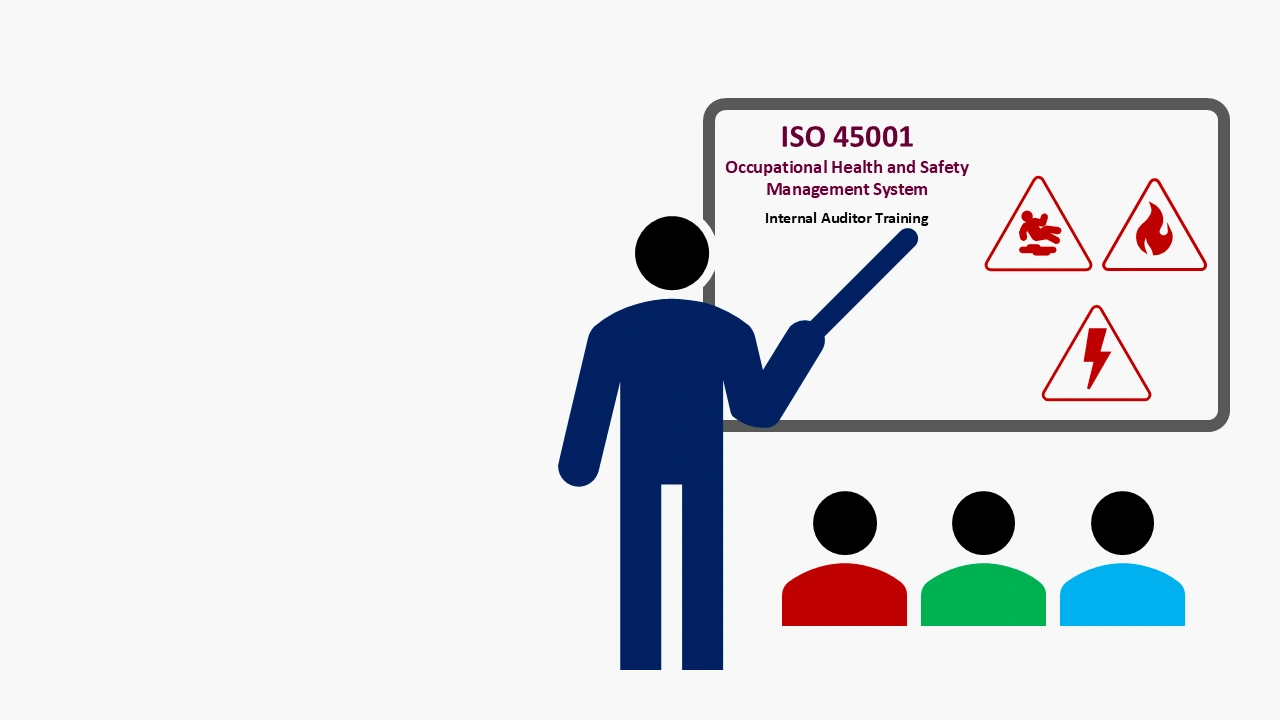
ISO 45001
Internal Auditor Training
ISO 45001 Internal Auditor Training – Master Workplace Safety Audits
Develop the skills to plan, conduct, and report internal audits, ensuring your OHSMS complies with ISO 45001 and promotes a safe work environment.
ISO 45001
ISO 45001:2018 is the international standard for Occupational Health and Safety Management Systems (OHSMS). It provides a structured framework for organizations to proactively manage workplace health and safety risks, prevent accidents, and promote a safe and healthy work environment for employees, contractors, and visitors.
The standard is designed to help organizations of all sizes and sectors identify hazards, assess risks, and implement effective control measures. By integrating a risk-based approach, ISO 45001 enables organizations to anticipate potential safety issues and take preventive actions, ensuring compliance with legal, regulatory, and contractual requirements.
ISO 45001 also emphasizes employee participation and leadership engagement, promoting a safety culture where everyone takes responsibility for occupational health and safety. The standard aligns with other ISO management system standards, such as ISO 9001 and ISO 14001, making it easier to integrate safety management into overall business operations.
Top Benefits
- Enhanced Workplace Safety – Helps identify hazards, reduce risks, and prevent accidents and injuries in the workplace.
- Legal and Regulatory Compliance – Ensures alignment with occupational health and safety laws, regulations, and contractual requirements.
- Reduced Workplace Incidents – Minimizes incidents, absenteeism, and associated costs by implementing proactive safety measures.
- Employee Engagement and Morale – Encourages participation in safety initiatives, improving awareness and fostering a culture of safety.
- Risk-Based Approach – Enables organizations to systematically assess, prioritize, and mitigate health and safety risks.
- Improved Reputation – Certification demonstrates commitment to employee safety, building trust with employees, clients, and regulators.
- Operational Efficiency – Reduces downtime, enhances productivity, and streamlines health and safety processes.
- Continuous Improvement – Promotes ongoing monitoring, evaluation, and enhancement of occupational health and safety management.
- Integration with Other Management Systems – Efficiently integrates with ISO 9001, ISO 14001, and other management standards for holistic organizational improvement.
- Global Recognition – Provides a status as internationally recognized, credibility and competitive advantage in local and global markets.
Principles
- Worker Participation and Consultation – Actively involves employees and their representatives in decision-making and safety management.
- Leadership and Commitment – Requires top management to demonstrate accountability, set safety objectives, and promote a culture of health and safety.
- Risk-Based Approach – Identifies, assesses, and mitigates workplace hazards and risks systematically.
- Hazard Identification and Control – Ensures hazards are identified, evaluated, and controlled to prevent injuries and ill health.
- Continual Improvement – Promotes ongoing monitoring, evaluation, and enhancement of OHSMS performance.
- Integration with Organizational Processes – Aligns occupational health and safety management with overall business processes for consistency and efficiency.
- Compliance with Legal and Other Requirements – Ensures adherence to applicable occupational health and safety laws, regulations, and contractual obligations.
- Preventive and Proactive Approach – Focuses on preventing incidents rather than reacting to them, fostering a culture of proactive safety management.
- Evidence-Based Decision Making – Uses data, audits, and performance metrics to guide safety management decisions and improvements.
- Protection of Worker Health and Well-Being – Emphasizes not only the prevention of accidents but also the overall physical and mental well-being of workers.
ISO 45001 Internal Auditor Training – Our Approach
Our ISO 45001 Internal Auditor Training is designed to equip professionals with the skills and knowledge to conduct effective internal audits of Occupational Health & Safety Management Systems (OHSMS) in compliance with ISO 45001 standards. Our ISO 45001 Internal Auditor training emphasizes practical auditing, risk identification, and continual improvement to ensure workplace safety and certification readiness. This structured approach ensures participants gain the knowledge, skills, and confidence to perform ISO 45001 internal audits that strengthen workplace safety, reduce risks, and support certification readiness. Our approach includes:
- Understanding ISO 45001 Requirements – Comprehensive overview of OHSMS clauses, standards, and compliance obligations.
- Audit Planning & Preparation – Learn to define audit scope, objectives, checklists, and risk-based planning.
- Process-Based Auditing Techniques – Conduct audits of workplace safety procedures, hazard controls, and operational processes.
- Evidence Collection & Reporting – Develop skills to gather objective evidence, identify nonconformities, and prepare professional audit reports.
- Corrective Actions & Follow-Up – Guidance on root cause analysis, corrective action planning, and verification of effectiveness.
- Hands-On Case Studies – Practical exercises to build confidence and real-world auditing capability.